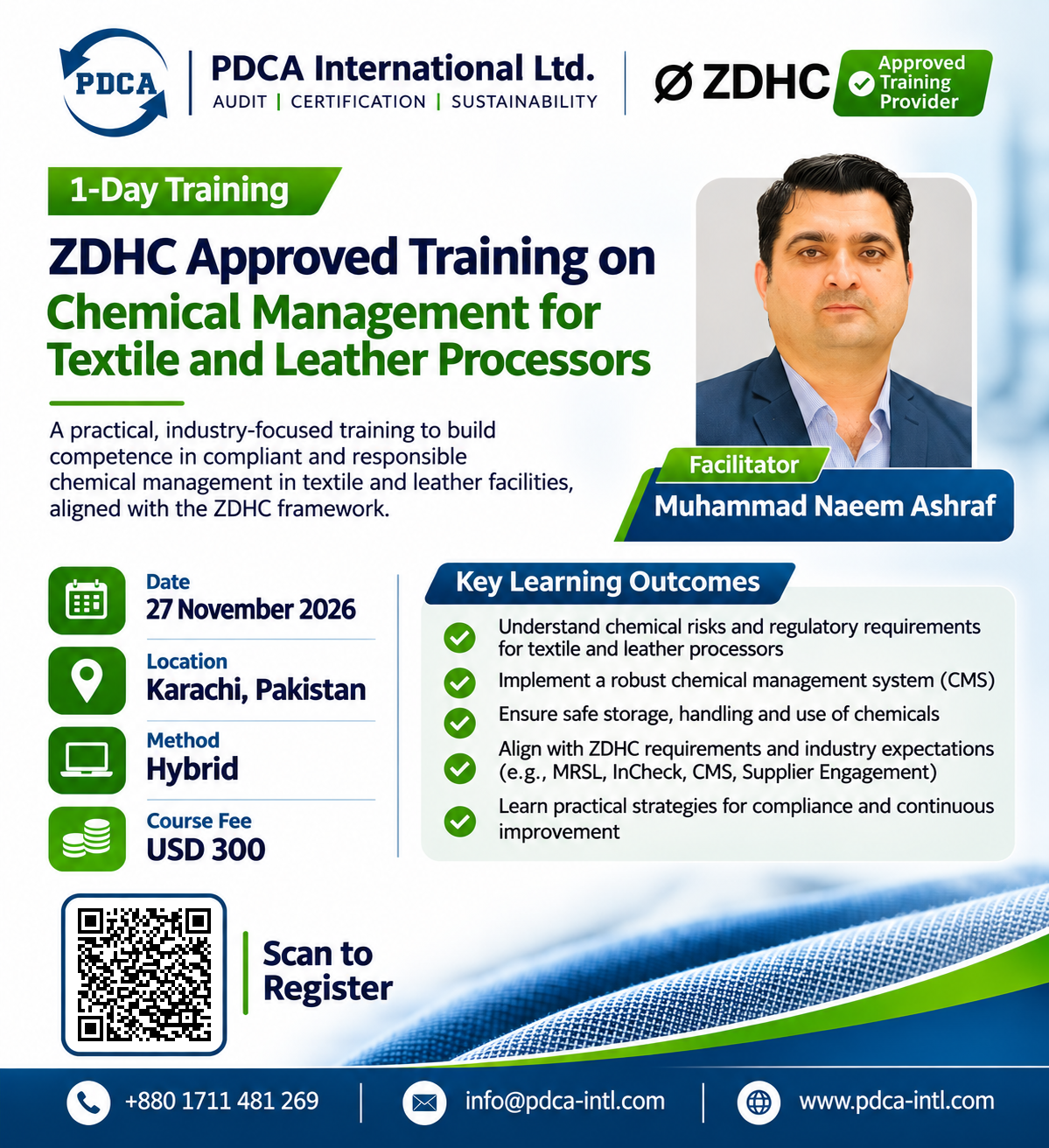
ZDCH Chemical Management for Textile and Leather Processors

Training Method:
Hybrid
Time:
09:00 AM - 05:00 PM
Duration:
8 Hours
Facilitator:
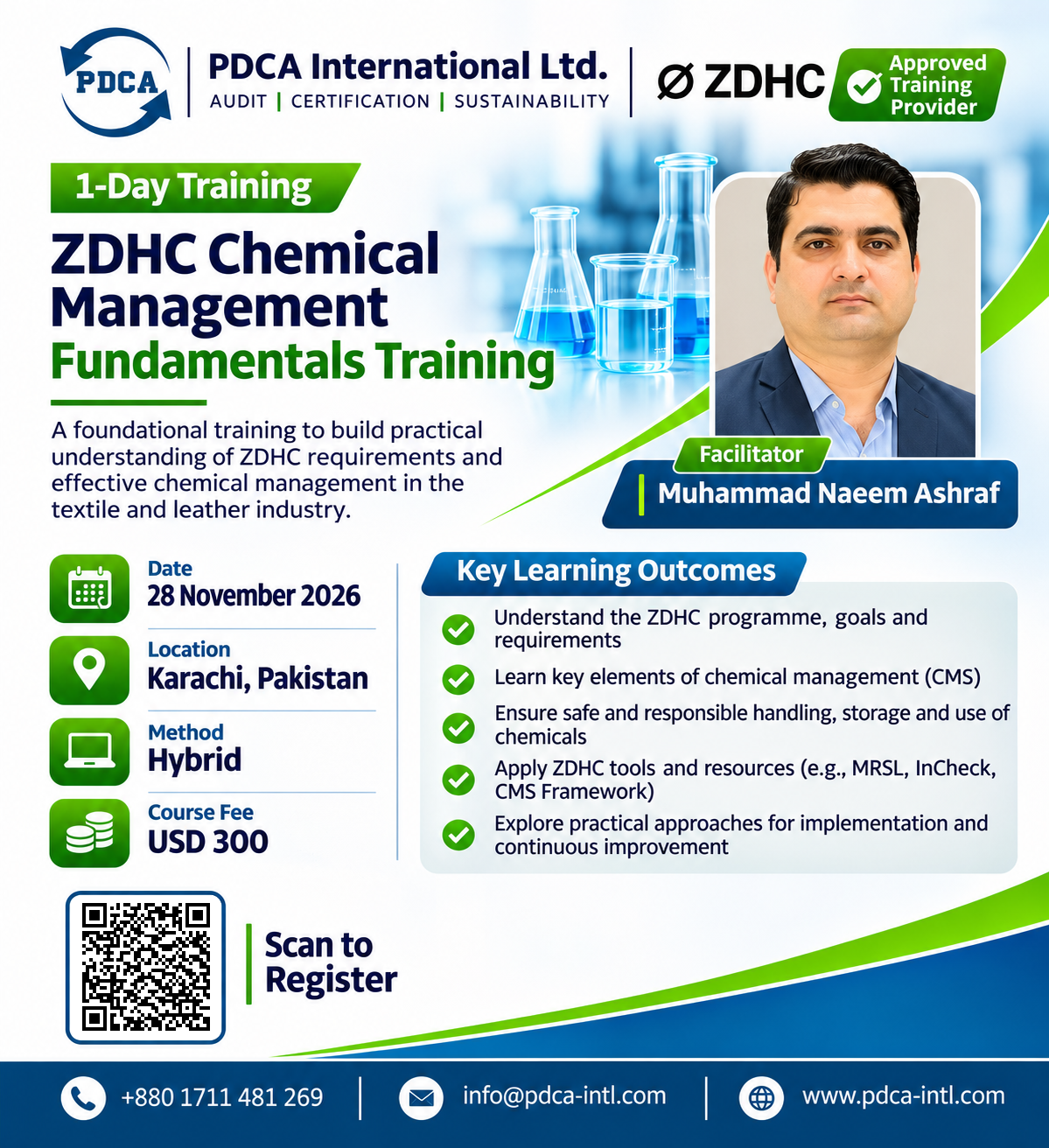
Muhammad Naeem Ashraf
Date:
27 Nov 2026
Location:
Karachi, Pakistan
session
Fee :
300.00 USD (Online) / 300.00 USD (Offline)
Facilitator:
Muhammad Naeem Ashraf
Date:
Schedule 1 Dates
27 Nov 2026

This Chemical Management for Textile and Leather Processors course on chemical management has been designed for textile and leather processors based on the digitized Suppliers Roadmap to Zero. This advanced level course will help you understand, implement and strengthen chemical management systems at your facility.

It has been designed for supplier facilities that manufacture materials which are used further in finished products/ end- articles and have chemical-intensive wet processes in their manufacturing facilities. These cover the following supplier profiles:

Textile:

  1. Accessories and trims processors
  2. Garment washing (laundry)
  3. Fibre, Yarn or Fabric processors (dyehouse)
  4. Pigment/ Panel/ Digital/ Transfer printing only
  5. Coating and/or lamination only (for synthetic footwear or other applications)
  6. Vertically integrated mill
  7. Sizing only
  8. Down and Feathers processor

Leather:

  1. Raw hide/ skin to tanned
  2. Raw hide/ skin to crust
  3. Raw hide/ skin to finished leather
  4. Raw hide/skin to pickled/pre-tanned leather
  5. Tanned hide/ skin to finished leather
  6. Crust hide/skin to finished leather
  7. Tanned hide/skin to crust leather


Learning outcome

By the end of this course, learners will be able to:

Input

  1. Develop and implement a chemical purchasing policy covering formulations, commodity chemicals, and solvents in line with ZDHC MRSL requirements.
  2. Maintain an accurate and up-to-date ZDHC Chemical Inventory List (CIL) and use it to drive purchasing and improvement actions.
  3. Generate and interpret ZDHC Performance InCheck Reports and take corrective actions to improve MRSL conformance.
  4. Implement chemical traceability, including lot/batch recording and FIFO practices, to support compliance, audits, and root cause analysis.
  5. Manage input materials through structured purchasing, traceability, self-declarations, certifications, and risk-based due diligence processes, including maintaining the ZDHC Material Inventory List (MIL).

Process

  1. Define the scope, goals, and action plan of a Chemical Management Strategy (CMS), including engagement with upstream suppliers.
  2. Allocate roles, responsibilities, and resources required for effective CMS implementation.
  3. Design, assess, and improve safe chemical storage systems, including labelling, chemical safety cards, and compatibility precautions.
  4. Identify chemical exposure risks in textile and leather processes and implement appropriate engineering, administrative, and PPE controls.
  5. Establish document and process control systems, including SOPs for document control, incident management, housekeeping, and maintenance.
  6. Review and improve the CMS through audits, management reviews, corrective actions, and structured training plans.

Output

  1. Identify, quantify, and manage chemical-related waste, including safe storage, handling, reduction, reuse, and disposal.
  2. Understand wastewater and sludge testing requirements, interpret ClearStream reports, and plan improvement actions based on results.
  3. Conduct RCA and CAP for MRSL, metals, and conventional parameter non-conformities in wastewater and sludge.
  4. Calculate Potential to Emit (PTE) for VOCs and understand the use of the ZDHC Air Emissions Module.
  5. Understand and report Scope 1 and Scope 2 GHG emissions using ZDHC tools.

Prerequisite

Learners should have any one of the following to sign up for this course:

  1. Chemical Management Fundamentals course certificate
  2. Chemical Management Fundamentals Exam only certificate
  3. Valid certificate of any one of the following courses:
  4. CMS TIG Training
  5. CMS TIG Refresher Training
  6. Top 10 Best practices

If you do not have either of the above, you will not be accepted into the training course.